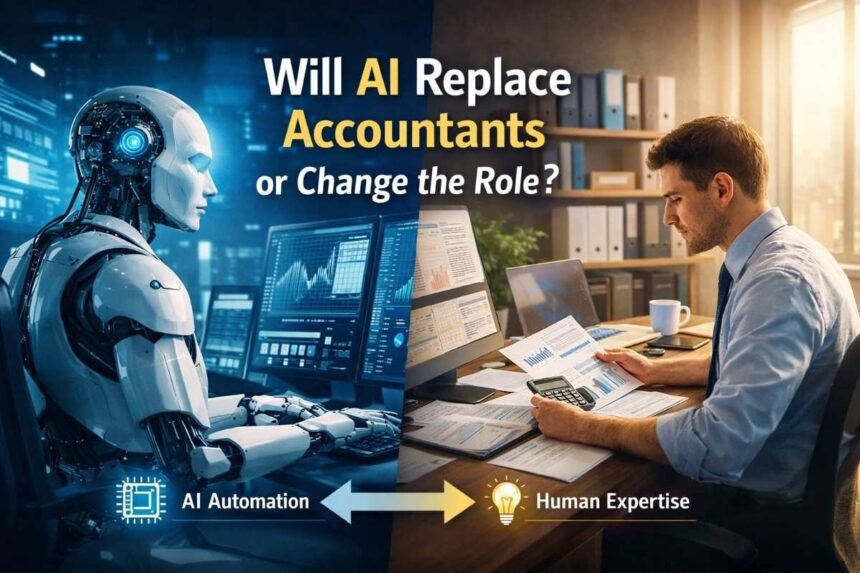
Artificial intelligence is changing how many jobs work, and accounting is no different. If you’ve ever wondered will AI replace accountants, you’re probably thinking about job security and whether this career still makes sense long term.
You might see software that automatically categorizes expenses, prepares reports, or helps with taxes and start asking will AI replace accountants in the future. That kind of change can feel unsettling, especially if you’re studying accounting or already working in the field.
For example, many small businesses now use automated bookkeeping software, but they still rely on an accountant to review the numbers and give real guidance. That human role hasn’t disappeared and that’s an important part of the story.
This article explains what AI can do today, what it still can’t do, and what all of this really means for the future of accountants.
What People Mean by the Question of AI Replacing Accountants
When people ask whether AI will replace accountants, they usually aren’t picturing robots taking over entire jobs overnight. What they’re really worried about is whether accounting work will still be needed as software gets smarter.
A lot of this concern comes from seeing AI handle tasks like data entry, invoice matching, and basic reporting. That naturally leads to questions like can AI replace accountants completely, or will human accountants still matter?
For example, expense-tracking software might automatically categorize transactions. That can feel like replacement at first. But it can’t explain tax strategy, spot unusual financial behavior, or guide someone through an audit. That’s where human judgment still matters.
At its core, this question is about job security, career stability, and how much human decision-making accounting will continue to require.
How AI Is Currently Used in Accounting
AI is already part of accounting, but its main role is to speed up routine work not replace people. It helps accountant’s process large amounts of data faster and with fewer errors.
Today, AI is commonly used for automated data entry, expense categorization, invoice processing, and bank reconciliations. That’s why people wonder how AI is changing accounting jobs and whether AI in accounting will replace humans over time.
For example, an accounting firm might use AI-powered software to scan receipts and post transactions automatically. Instead of spending hours entering numbers, the accountant reviews the results, fixes issues, and focuses on analysis and client advice.
Right now, AI works as a support tool, not a system that can run accounting operations on its own.
Accounting Tasks That Can Be Automated by AI
Some accounting tasks are easier for AI to handle because they’re repetitive and rule-based. These are the areas where automation has grown the fastest.
AI can automate data entry, transaction categorization, invoice matching, payroll calculations, and basic bank reconciliations. Since these tasks follow clear patterns, software can handle them well.
For example, modern bookkeeping software can automatically import bank transactions and label expenses. Instead of entering every line manually, a bookkeeper reviews the results and corrects anything unusual.
Automation reduces manual work, but it doesn’t eliminate the need for accountants to check accuracy, handle exceptions, and make decisions.
Accounting Tasks That Cannot Be Fully Replaced by AI
Some parts of accounting are much harder for AI to replace because they depend on human judgment, experience, and context.
Tax planning, financial strategy, audit decisions, and client advising all require understanding goals, risks, and changing rules. AI systems can organize data, but it can’t fully understand a business owner’s situation or make judgment calls when there isn’t a clear answer.
For example, during a tax audit, an accountant may need to explain deductions or respond to questions from tax authorities. That kind of judgment goes beyond automation.
These higher-level responsibilities are a big reason accounting jobs aren’t disappearing, even as technology improves.
AI in Accounting vs Human Accountants
AI excels at processing data quickly and handling repetitive accounting tasks. Human accountants provide judgment, ethical responsibility, and strategic advice that software cannot replace. The most effective accounting roles combine AI efficiency with human decision-making.
How AI Is Changing Entry-Level Accounting Roles
AI is affecting entry-level accounting roles more than any other part of the profession. Many beginner tasks that once took hours are now automated.
New accountants spend less time on data entry and more time reviewing reports, checking for errors, and learning how accounting systems work. The role hasn’t vanished, but the daily work looks different.
For example, a junior accountant might review AI-generated reconciliations instead of creating them from scratch. Their value comes from spotting mistakes and understanding why numbers don’t match.
Entry-level roles now require analytical thinking earlier than they used to.
How AI Is Affecting Senior and Specialized Accounting Positions
Senior and specialized accounting roles are impacted differently. Instead of replacing these positions, AI mainly supports decision-making and improves efficiency.
Experienced accountants use AI to analyze large data sets, identify risks, and spot trends faster. Final decisions still rely on judgment, experience, and client relationships.
For example, a senior accountant might use AI tools to flag unusual transactions, then determine whether they signal fraud, a reporting issue, or a business change.
At this level, AI acts more like an assistant than a replacement.
Whether AI Can Fully Replace Accountants in the Future
There’s currently no strong evidence that AI will fully replace accountants. Even as technology advances, AI still works best with human oversight.
Accounting roles involve judgment, ethics, communication, and accountability. These are areas where machines still fall short.
For example, AI can generate financial reports, but a human accountant must explain the results, answer questions, and stand behind the advice given.
The future of accounting looks far more like working alongside AI than being replaced by it.
Expected Timeline for AI’s Impact on Accounting Jobs
AI is already influencing accounting jobs, but the changes are happening gradually.
In the short term, AI focuses on automating repetitive tasks. Over the next several years, it will improve at analysis and reporting, but full job replacement is unlikely.
Accounting rules and tax laws change too often for AI to operate independently. That’s why many experts believe AI replacing accountants would take decades, if it happens at all.
Most accountants will see their roles evolve, not disappear overnight.
Skills Accountants Need to Remain Relevant as AI Advances
As AI becomes more common, accountants stay relevant by focusing on skills technology can’t easily replace.
Critical thinking, problem-solving, communication, and understanding business context matter more than ever. Learning how to work with AI tools is also essential.
For example, an accountant who understands both tax rules and AI-powered reporting software can explain results clearly and catch issues software might miss.
The goal isn’t to compete with AI, but to use it to deliver better insights.
Whether Accounting Remains a Safe Career Choice with AI
Many people ask whether accounting is still a safe career with AI. The short answer is yes but the work is changing.
AI reduces manual tasks but doesn’t replace the need for professionals who understand rules, ethics, and real business decisions.
Even when software prepares financial statements, a licensed accountant is responsible for reviewing and approving them. That responsibility still matters.
Accounting remains a stable, long-term career for those willing to adapt.
How Accountants Can Work with AI Rather Than Be Replaced
Accountants are far less likely to be replaced when they use AI as a tool instead of seeing it as a threat.
Working with AI means letting software handle repetitive work while you focus on review, strategy, and advice.
For example, an accountant might use AI to generate forecasts, then adjust them based on real-world factors the software can’t understand.
The most secure accountants combine technology with human judgment.
Experience-Based Advice from the Field
- Accountants who adopt AI early tend to move into advisory roles faster
- Firms that resist automation often struggle to compete on price and speed
- The biggest gains come from learning how to review AI output, not just using tools
AI rewards accountants who think critically, not those who only process data.
Common Mistakes Accountants Make With AI
- Assuming AI will “figure everything out” without review
- Avoiding AI tools out of fear instead of learning them
- Over-relying on automation without understanding the data
- Failing to build communication and advisory skills
AI mistakes usually come from lack of oversight, not the technology itself.
Quick Checklist
- Learn at least one AI-powered accounting tool
- Strengthen review and analytical skills
- Stay current on tax laws and regulations
- Improve client communication skills
- Treat AI output as a draft, not a final answer
Final Thoughts
AI is changing accounting, not replacing it. Accountants who learn to work with AI will remain in demand, while those who resist change may struggle. The future belongs to professionals who combine technology with human judgment.
FAQs
Will AI replace accountants completely?
No. AI replaces tasks, not the full role of an accountant.
Will bookkeeping jobs disappear first?
Bookkeeping is more automated, but human review is still needed.
Is accounting still worth studying?
Yes, especially for those willing to adapt and learn new tools.
Can AI replace CPAs?
AI can support CPAs, but licensing, judgment, and responsibility remain human.
How can accountants future-proof their careers?
By learning AI tools, strengthening analytical skills, and focusing on advisory work.